


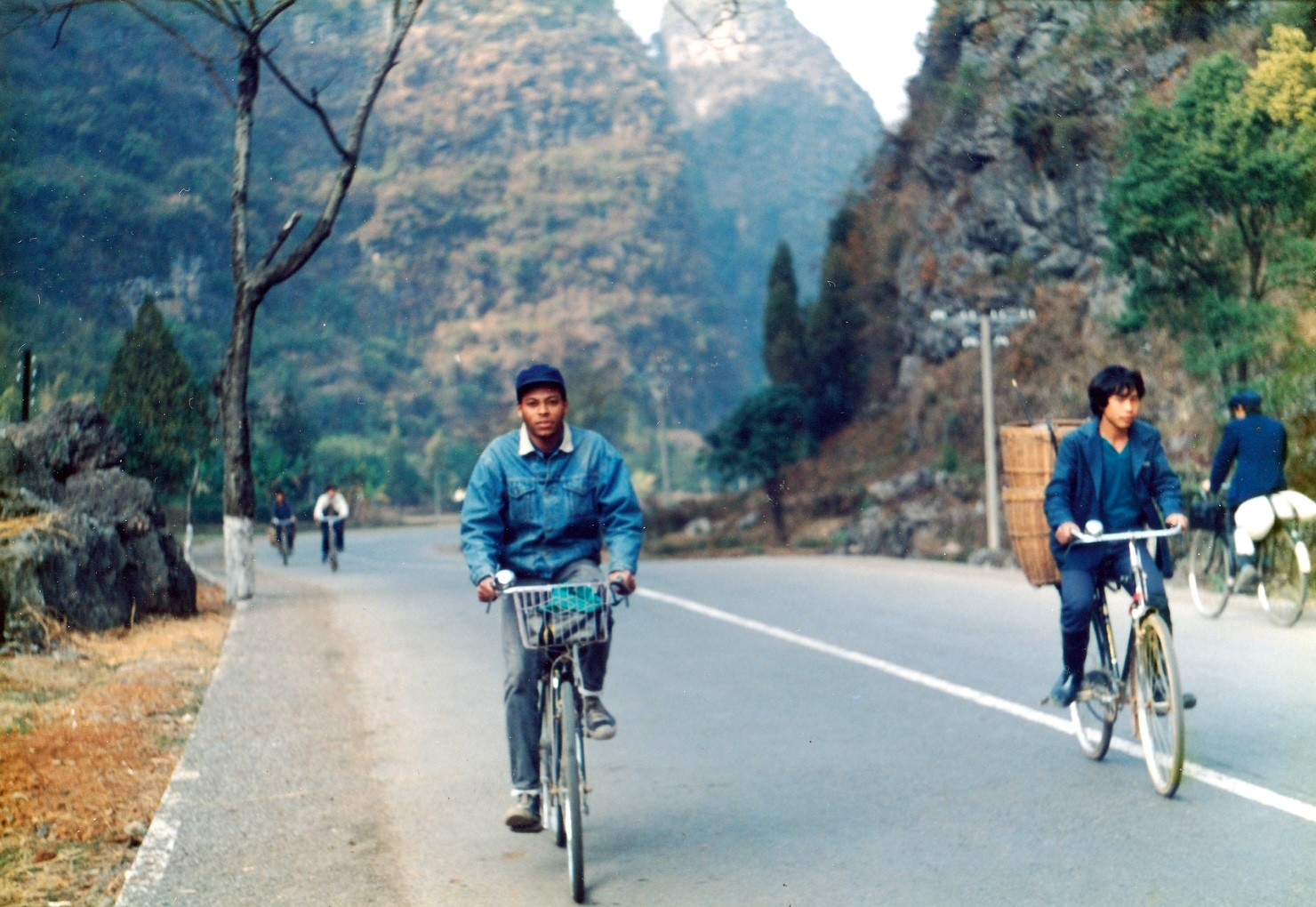
 A Puerto Rican family (mother and two teenage daughters) in the store keenly observed this interaction. One of the daughters asked me, ‘Can you say that again?’ Realising I was now THE in-store entertainment, and enjoying the brief sensation of being the centre of attention, I quickly rose to the occasion and turned to face the family. ‘Can I have that bar of soap please?’ I repeated. The family loved it. Smiling with me as my act was completed. We then had a brief chat. Questions were asked about where I was from, and why I spoke the way I did.
Author in a store in Brooklyn, New York, USA, 1985
Extract from Seen and Heard: Film and television, Music, Sport, Travel and Letters
Cricket in our household was massive because my mum was really fanatical about the game and absolutely loved it. Everything had to be done in the house before a cricket match started on TV. The dhal had to be done, the curry done, and the roti clapped and sorted! I always remember a spanking clean house and we had an armchair sofa which was positioned in front of the TV. And then, yes, mum would just sit there glued to the TV watching cricket. My sisters and I weren’t into cricket to a massive extent, but my younger brother was really into it. He had a signed West Indies cricket bat and Rohan Kanhai and Alvin Kallicharan were his cricket heroes. It’s only now, when I look back to how important West Indies cricket was to our culture and history, I remember the story that kept coming back to us that, ‘Oh my God, there is someone on TV who really looks like us’. Kanhai and Kallicharan were from Berbice (in Guyana), and not very far from where our family lived. So, we all felt a connection with them.
Lainy Malkani, Director of the Social History Hub, UK, author and journalist
Extract from 1973 and Me: The England v West Indies Test Series and a Memorable Childhood Year
“West Indies cricket continued to provide some Caribbean migrants with their primary source of expression, and the poise and confidence to charter a path towards recognition and assimilation: There was only one way of expressing West Indian character and a Caribbean presence, and that was cricket. Because it came out of Britain in the first place it offered a sort of bridge into the English culture. We understood what it meant to be part of this society, partly because we understood cricket. The English perceived cricket as a sort of commentary on themselves and who they were. We had a very similar sense of who we were coming out of the nature of cricket and the way it was played. To be here (in Britain) and be exposed to cricket matches between the West Indies and English was, in fact, to be a home from home.”
Mike Phillips, Academic, broadcaster and writer
Extract from They Gave the Crowd Plenty Fun: West Indies Cricket and its Relationship with the British-resident Caribbean Diaspora